
Universal Translator: Making Sense of Phase Change
Most people don’t recognize the exact moment their thinking stops matching their environment. They don’t notice the boundary between clarity and confusion, where confidence becomes hesitation and yesterday’s approach no longer fits today’s reality.
But they do feel it.
Pressure.
Friction.
Overload.
The sense that something subtle—or not so subtle—has shifted.
That’s why the Decoder came first.
You have to feel Phase Change before you can translate it. You have to sense what’s happening inside your system before you can make sense of it.
Phase Change, simply put, is the moment when your internal or external environment shifts enough that your usual way of thinking is no longer optimal.
If you read the Decoder article, you’ve already seen how Phase Change feels in real time—the signals, sensations, disruptions, and internal shifts that announce the beginning of a new cognitive state. The Decoder met you exactly where Phase Change first becomes detectable: in the feeling layer.
But feelings alone can’t guide you through change. Feelings are signals. Thinking is interpretation. And most performance breakdowns happen because people make decisions based on what they feel instead of what those feelings actually mean.
The Decoder taught you to notice the signals.
The Universal Translator teaches you to understand them.
Welcome to the Universal Translator—the interpretive layer of the Phase Change Operating System. If the Decoder showed you what Phase Change feels like, the Universal Translator shows you what those feelings mean.
This is how you translate the signals your system sends you.
Why The Decoder Came First
Operators don’t learn abstract models first. They learn through:
- pattern recognition
- visceral experience
- relevance
- internal cues
- emotional signal detection
In aviation, medicine, special operations, and leadership, the best training begins with experience, then interpretation.
A pilot notices a flicker on the panel. A medic sees a teammate freeze for half a breath. A CEO hears tension tighten a briefing. These micro-signals are often the earliest signs of Phase Change.
You can’t run a cognitive protocol without first learning to recognize the cues that tell you a protocol is needed.
Signal → Translation → Action.
The Decoder built your signal awareness.
The Universal Translator builds your meaning-making.
What The Universal Translator Is
The Universal Translator is not the full Phase Change OS. It is the bridge between experience and protocol—between what happens and what you choose to do next.
It gives you:
- the concept map behind cognitive state shifts
- the distinctions that separate signal from noise
- the thresholds that matter most during disruption
- the structure behind solid, liquid, and gas thinking
- the language to interpret what the Decoder taught you to feel
Think of it like the device on the bridge of the Enterprise. The Universal Translator doesn’t create a new language—it converts signals into meaning your system already understands.
Your system already communicates.
Now you learn how to understand it.
Just as the fictional Universal Translator adapts across species, cultures, and communication styles, this interpretive layer adapts across different cognitive styles and processing patterns. People sense friction differently. People shift states at different speeds. People notice different signals first.
The Universal Translator makes that variation legible—without asking anyone to change who they are.
The Language of Phase Change OS
Here’s what surprises most people:
The Phase Change OS doesn’t tell you what to think. It gives you the protocol for how to think when conditions change.
Not a mindset.
Not a philosophy.
Not a personality trait.
A thinking protocol.
But not a rigid one.
This isn’t a checklist or script. It’s an adaptive reasoning process—the same kind high-performing operators use when reality shifts faster than procedures can update.
It gives you:
- a way to detect what state you’re in
- a framework for matching your thinking to that state
- a protocol for shifting modes when the environment changes
- a discipline for recovering cognitive clarity under pressure
This is why PCOS is trainable.
This is why it can be practiced.
This is why it works across leadership, crisis, strategy, coaching, and daily life.
Avoiding The Rigidity Trap
People hear “protocol” and fear rigidity. But rigid systems collapse under Phase Change.
PCOS is built on structured flexibility:
- The structure prevents cognitive overload.
- The flexibility prevents brittleness.
If you want a modern analogy, think of how an AI model reasons. It doesn’t follow rigid code. It follows a flexible reasoning protocol that adapts to context.
Same model.
Different output.
Driven by input signals.
That’s PCOS.
It doesn’t dictate answers.
It structures the thinking that produces better answers.
It is the meta-protocol for cognition under change.
How The Pieces Fit Together
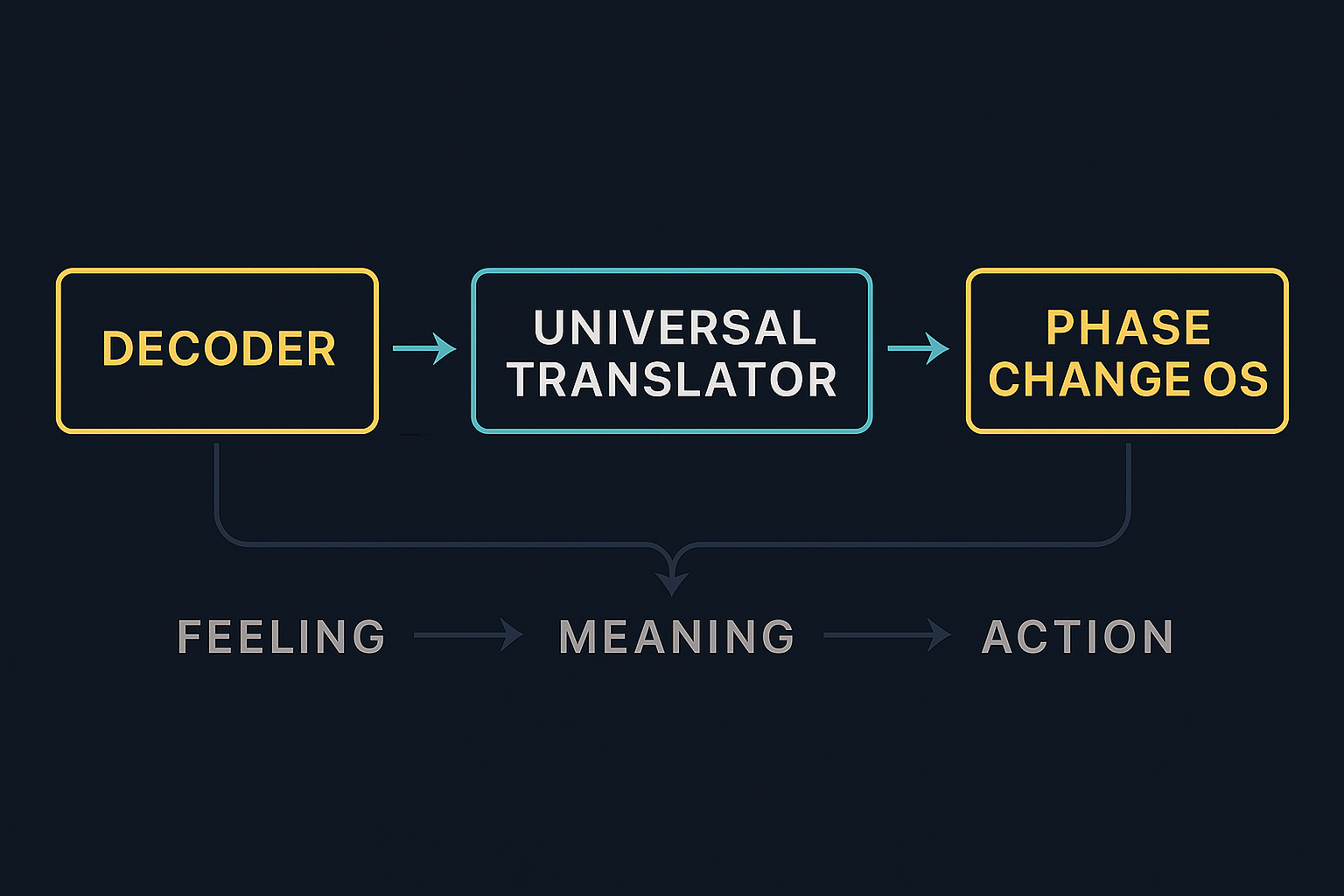
You’ve now encountered all three components of the Phase Change architecture, just not all at once:
1. The Decoder — Signal Awareness
What Phase Change feels like. The cues, sensations, disruptions, and internal shifts that tell you something is changing.
2. The Universal Translator — Meaning-Making
How to understand the signals. The language, distinctions, and conceptual structures that reveal what those internal cues mean.
3. The Phase Change OS — Protocol
How to respond. The disciplined reasoning process that guides adaptive action once you understand the state you’re in.
Or more simply:
Feeling → Meaning → Action
Decoder → Universal Translator → OS
This is the full path from noticing change to navigating it.
What Comes Next
Once you understand the Universal Translator, you’re ready for the core protocol underneath it.
Upcoming articles will explore:
- The Three Thresholds
- Solid / Liquid / Gas Thinking
- Cognitive State Mismatch
- Collapse and Recovery
- Behavioral Syntax for Operators
- Phase Change Drills
But not yet.
For now, your task is simple:
Start noticing the signals.
Start translating what they mean.
Start seeing your thinking as something that can shift with purpose.
You’ve learned the signals.
Now you understand the language.
Soon, you’ll run the protocol.
This is the Universal Translator.
Let’s make sense of Phase Change.